
Review · WALKING TOURS
Walking tour of Plovdiv’s top attractions
Plovdiv has layers, and this walk strings them together. You get a private 2 to 3 hour route through the city’s top sights, with commentary that helps you see how the Roman, Thracian, and Bulgarian Revival periods overlap. I love that it covers big-name landmarks without turning into a marathon, and I also like the built-in structure, it is easy to follow and it helps you get your bearings fast. One thing to consider: several stops list admission as not included, so you may want a little extra budget for tickets once you reach the museum and house interiors.
My favorite part is the pacing. Short stops, a clear order, and time to absorb what you are actually looking at, from inscriptions in the Ancient Stadium to the panoramic hilltop views at Nebet Tepe. The guide matters here, and the one highlight from a recent 5-star review was how well Adi handled questions and kept the balance of charm and real subject matter. The only drawback I see for some people is that it is not recommended if you have mobility issues, so check your comfort with walking before you book.
If you want a smart orientation to Plovdiv, this kind of tour is hard to beat. You will come away with a mental map of the Old Town and the hills, plus enough context to enjoy the city on your own afterward.
In This Review
- Key things I’d watch for on this Plovdiv walking tour
- Why this tour feels like a smart orientation to Plovdiv
- Park Tsar Simeon, where Plovdiv starts looking like a city you can live in
- The Ancient Stadium of Philippopolis, plus the Hadrian-era details most people miss
- The Roman Theatre, the crown jewel with inscriptions and seat politics
- St. Konstantin and Elena Church, built on older ground, rebuilt many times
- Hisar Kapia area, the medieval gate and the acropolis story
- Ethnographic Museum in the Revival house, 40,000 artifacts and a house you can read
- Nebet Tepe archaeological complex, copper age beginnings and big hilltop views
- Balabanov House, Revival architecture with carved ceilings and a modern art layer
- Hindliyan’s House, the Neo-Baroque home with postcard-like wall scenes
- Kapana, the art district with cobblestones and painted facades
- Price and value, what you are really paying for at $86.90
- Who this tour suits best, and who should rethink it
- Should you book this Plovdiv walking tour?
- FAQ
- How long is the Plovdiv walking tour?
- Is this a private tour?
- Does the tour include hotel pickup and drop-off?
- Are tickets included for all stops?
- What are some of the main attractions included?
- Is the tour suitable for people with mobility issues?
- Is a mobile ticket provided?
- What is the cancellation policy?
Key things I’d watch for on this Plovdiv walking tour
- Private pacing for 2 to 3 hours, ideal when you want a focused hit of highlights
- Complimentary pickup and drop-off so you are not starting the day stressed
- Roman Theatre area and Thracian hill views at Nebet Tepe, not just streets and facades
- Revival house details like carved ceilings and painted wall scenes at Balabanov House and Hindliyan’s House
- Some interiors cost extra, since ticketed sites are not included in the price
Further Walking Tours in Plovdiv
- Private city walking tour of Plovdiv★ 5.0 · 65 reviews
- Plovdiv: Guided Walking Tour★ 4.3 · 41 reviews
- Food Walk: Bulgarian Food and Culture Tour in Plovdiv★ 5.0 · 35 reviews
- Plovdiv guided walking tour★ 5.0 · 31 reviews
Why this tour feels like a smart orientation to Plovdiv
Plovdiv can be tricky in the best way. The Old Town climbs across three hills, streets twist in unexpected directions, and the city keeps switching time periods on you. This tour is designed to solve that problem with a compact walk and a local guide who knows how to connect the dots.
You start at Park Tsar Simeon, one of the city’s green breathing spaces, then you move into the Roman layer, and later you bounce back to Bulgarian Revival architecture and craft district life in Kapana. That mix matters because it turns your sightseeing into a story you can remember, not a checklist you forget.
The tour is private, meaning it is only your group. That helps when you have questions about what you are seeing or if you want the guide to slow down at a specific viewpoint. You also get mobile ticket support, plus a pickup option, and the highlight list calls out complimentary hotel pickup and drop-off.
Park Tsar Simeon, where Plovdiv starts looking like a city you can live in
Your first stop is Tsar Simeon Garden, a large green area that local life clearly wraps around. Expect statues, monuments, fountains, memorials, and tidy paths that lead toward the Main Street feel of the city. It is not just a pause, it is a way to reset your eyes before you step into the Old Town and its steep, archaeological atmosphere.
I like this start because it softens the day. Instead of immediately jumping to ruins and churches, you begin with a park that has lanes for strolling, and even a children’s playground. If you are arriving from travel fatigue, this opening makes the rest of the route feel calmer and more manageable.
If you do this on a warm day, plan for shade breaks and water. The park is a breather, but the walking still comes later.
The Ancient Stadium of Philippopolis, plus the Hadrian-era details most people miss
From the park you shift into Roman Plovdiv at the Ancient Stadium of Philippopolis, also known as the Stadium of Trimontium. This is one of the largest Roman structures on the Balkan peninsula, and you see it in a very realistic way because much of it sits under the city. What is exposed is the northern part, open to visitors.
Here is what I found most useful for understanding what you are looking at: the site includes a miniature model showing what the stadium looked like when it was built in the early 2nd century AD, during the reign of Emperor Hadrian. The real stadium measured about 240 meters long and 50 meters wide, and it could seat up to 30,000 people. That scale helps your brain, especially when the remaining visible portions feel smaller than the stories.
You also get a strong human detail. Some seats have engravings with names in Greek, pointing to reserved seating for people of high status. The guide can connect this to the kinds of events held there, including games similar to the Pythian Games in Greece.
This stop is short, so you will want to focus on the model and the inscriptions area. Even a quick visit makes a difference if your guide points out where to look.
The Roman Theatre, the crown jewel with inscriptions and seat politics
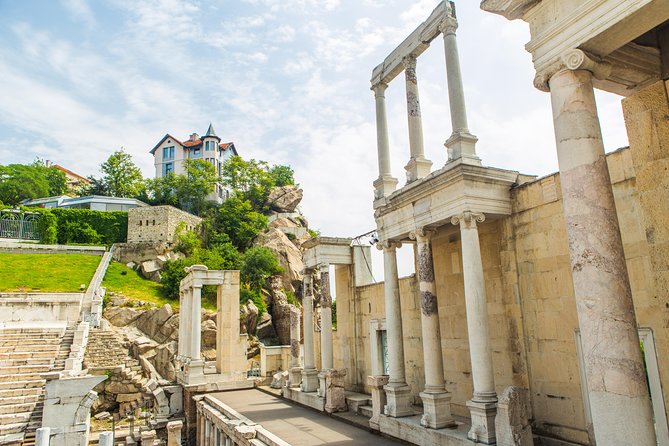
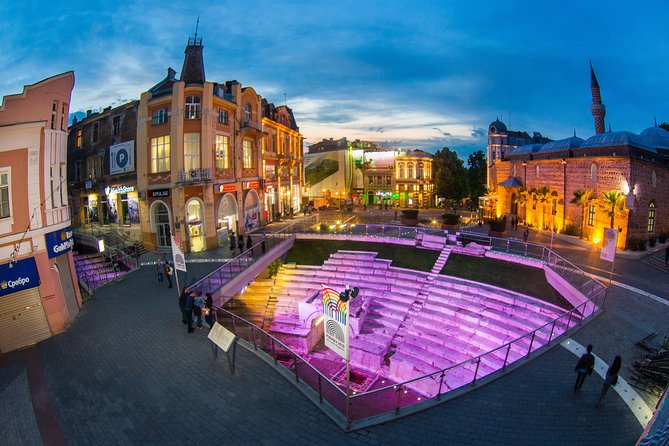
Next up is the Ancient Theatre of Philippopolis, often called the Roman Theatre. It is one of the best preserved theatres in the world, and it helps to stand in the right place because the structure is framed by the hills of the Old Town. The theatre sits between Dzhambaz Tepe and Taksim Tepe and looks over the southern side of the city.
The theatre was constructed in the 1st century AD. It was used for theatre performances, gladiator games, and hunting spectacles. That range is why this site is so memorable. A Roman theatre was not a single-purpose place, it was entertainment with an audience built into the architecture.
The inscriptions are the part I would not rush past. They mark seats reserved for notable members of Roman society, and they also suggest the theatre played a role as a seat of the Thracian Provincial Assembly. When your guide explains that, you start to notice how the stones were organized around power and status, not just crowd comfort.
Admission for this stop is not included, so expect you might pay an entry ticket if you go inside. Even if you do not, the exterior views and the framing of the hills still give you a real sense of the theatre’s importance.
A different sort of day from the same city:
- Plovdiv: Bachkovo Monastery, Asen Fortress, & Bridges Tour
★ 5.0 · 56 reviews - Wonderful Bridges-Bachkovo Monastery-Assen’s Fortress – day tour from Plovdiv
★ 5.0 · 32 reviews - Bachkovo Monastery & Asen’s Fortress – day tour from Plovdiv
★ 5.0 · 28 reviews
St. Konstantin and Elena Church, built on older ground, rebuilt many times
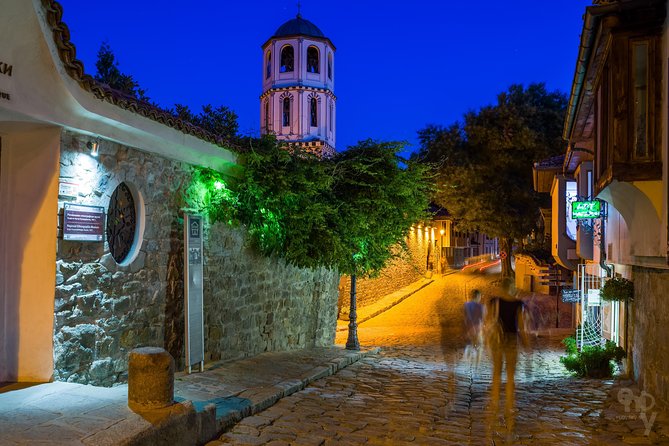
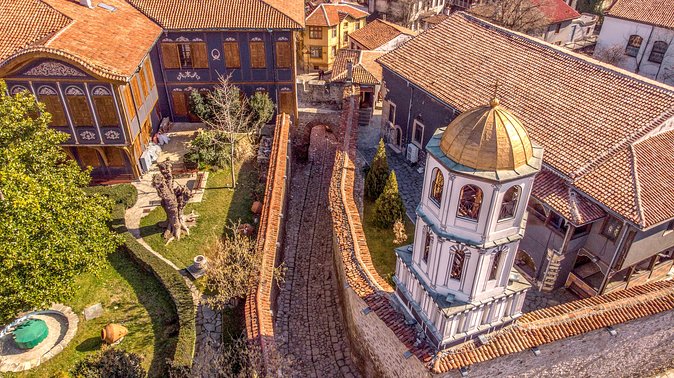
Then you shift from Roman spectacle to a church with a long timeline. St. Konstantin and Elena Church sits on a site where an earlier pagan temple existed, and the original church is dated to the year 337. Over centuries, it was destroyed and rebuilt, so the place carries a layered past rather than one single snapshot.
A standout detail is the art history: the church contains icons by the famous Bulgarian painter and iconographer Zahari Zograf. That helps turn a quick church stop into something more specific than generic religious architecture.
The church you see today dates to 1832, which the tour description notes makes it the oldest church in Plovdiv in its current form. Even if you are not an art person, the guide’s context helps you see why this stop anchors the Bulgarian Revival era while sitting on much older religious foundations.
Admission is listed as free here, so you can keep this as a relaxed break in the route.
Hisar Kapia area, the medieval gate and the acropolis story
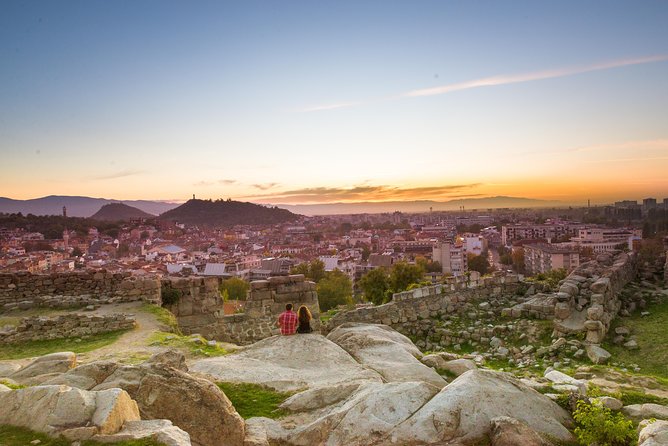
You then move through the area around Hisar Kapia, a medieval gate built in the 11th century AD. The description makes it clear this gate stands on the foundations of an older Roman-period gate, which matters because you are seeing a reuse of strategic infrastructure over time.
The gate once served as the Eastern entrance to the acropolis of ancient Plovdiv. Today, you get another time period on top of it: the gate is framed by Bulgarian Revival period houses built into the walls of the former fortress. In other words, the architecture is not just a ruin, it is part of the living street scene.
This is one of those stops where the value is in orientation. You start to understand how the fortress edge shaped where people built and how movement through the city worked.
Admission is listed as free for this stop, so think of it as a quick “place yourself” moment.
Ethnographic Museum in the Revival house, 40,000 artifacts and a house you can read
On the western side of Hisar Kapia is the Plovdiv Regional Ethnographic Museum. This one is for people who like object detail, because it houses a collection of about 40,000 cultural artifacts.
Expect items that cover everyday life and craft: furniture, musical instruments, clothing, pottery, tools, and household objects. That is exactly the kind of inventory that makes a region feel real, since you are seeing how people lived, not just what elites built.
The building itself is part of the appeal. The museum sits in an intricately decorated Bulgarian Revival period house that includes Baroque elements. In plain terms, you get two layers in one stop: the objects and the stage they sit on.
Admission is not included, so you may need tickets or a paid entry. If you are trying to prioritize, I would only skip this stop if museums do not interest you at all. If you like cultural context, it fits beautifully with the Roman and Thracian sites you just saw.
Nebet Tepe archaeological complex, copper age beginnings and big hilltop views
After the museum, you head to Nebet Tepe, the northernmost of Plovdiv’s three syenite hills. This hill is where Plovdiv’s oldest iteration once stood. The settlement began as far back as the Copper Age and later grew into the Thracian city of Eumolpia.
You can access fortress ruins from here, and the payoff is the view. Nebet Tepe offers panoramas looking out to the east, north, and west sides of the city. Even if you only spend a few minutes on the viewpoint, it helps you connect what you saw earlier at the theatre with the geography of the hills.
Admission is listed as free for this stop, which makes it a high-value moment. You are getting both context and perspective, and you do not have to spend extra just to access it.
If you visit when the sun is strong, remember that hill viewpoints can get bright and windy. A hat helps more than you think.
Balabanov House, Revival architecture with carved ceilings and a modern art layer
Balabanov House is one of the most impressive Revival period buildings on this route. It is known for dramatic architecture, detailed furniture, wall paintings, and intricate woodcarvings on ceilings. The tour description notes that the ceiling design is unique in each room, which is exactly the kind of detail that makes you slow down.
The layout also gives you two different experiences back to back. The ground floor functions as an art gallery with a permanent exhibition of modern Bulgarian art. Upstairs, the second floor is lavishly furnished with late Baroque furniture.
That combination can be a little unusual in the best way. You are touring a historic Revival home, then you are also inside a space that shows modern Bulgarian art, so you are not only looking backward.
Admission is not included for Balabanov House, so this is where your extra ticket budget can show up. If you enjoy interiors, this stop is one of the big reasons to take this tour instead of a self-guided walk.
Hindliyan’s House, the Neo-Baroque home with postcard-like wall scenes
Next comes Hindliyan’s House, built between 1835 and 1840. It belonged to the merchant Stepan Hindliyan, and the house is described as a standout example of Symmetrical Plovidv Architecture, with a Neo-Baroque design.
The interior is ornamented with intricate ceilings, and the walls include detailed landscapes handpainted with scenes from far-off places. One of the most memorable specifics: niches with wall murals depict scenery from Stockholm, Lisbon, Saint Petersburg, Athens, Istanbul, Venice, and the description suggests these were likely reproduced from postcards and engravings that Hindliyan brought back from travel.
That detail is a gift because it changes how you see the whole Old Town. These houses were not isolated local boxes. The owners moved through a wider world through images, and that shows up in the art.
Admission is listed as not included here too. If you like interior design and painting, do not treat this as a quick exterior photo stop.
Kapana, the art district with cobblestones and painted facades
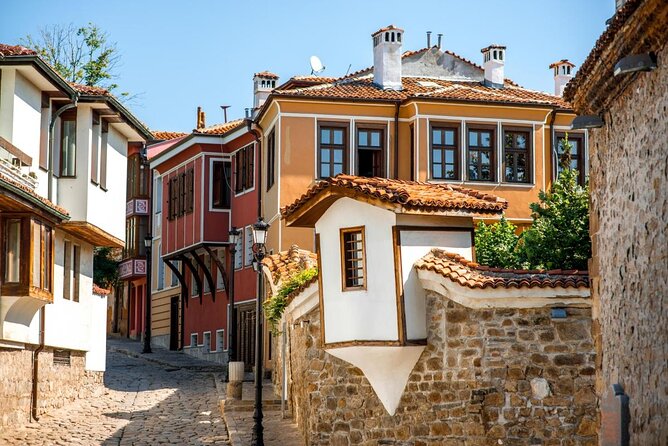
Finally, you end in Kapana, the art district of Plovdiv. The name Kapana means Trap, and the district fits it. Expect a labyrinth of cobblestoned streets lined with workshops and artists’ spaces.
Kapana started as a center for craftsmen back in the 15th century, and it evolved into an art hub for many kinds of creators. Today it includes modern art stores, small cafes and restaurants, and building facades that are works of art themselves. The walls are colorfully painted by street artists, and the route can include modern art pieces scattered around corners.
This is a great ending because it gives your day a modern pulse. After Roman ruins and Revival interiors, you finish with a neighborhood where creativity is still happening.
Admission is free for this section, and the atmosphere is the value. Even if you do not stop to eat, you can still enjoy the street art and the way the district feels like an open gallery.
Price and value, what you are really paying for at $86.90
At $86.90 per person, this tour sits in the midrange for a guided Old Town walk that includes pickup and a private format. The key is what you get for that price.
First, the time is compact, 2 to 3 hours, so you are not paying for a whole day you could spend exploring on your own later. Second, you get a local guide included, and that matters most at places where the details are easy to miss, like inscriptions in the stadium and theatre seating. Third, you get complimentary hotel pickup and drop-off, which is a real convenience in a hill city where getting from site to site can eat up time.
Also note what is not included. Admission is listed as free for several stops, including the park, stadium (outside areas), St. Konstantin and Elena Church, Nebet Tepe, and the final Kapana area. But the theatre and multiple interior-focused stops like the ethnographic museum and historic house museums are listed with admission not included.
So the value works best if you actually want at least some interior entries. If you prefer only outdoor sights, your total might be lower. If you want all the interiors, you should be ready for extra ticket costs.
Who this tour suits best, and who should rethink it
This tour is a strong match if you want:
- A private Plovdiv introduction without spending hours planning
- A route that connects Roman sites with the Bulgarian Revival era
- A guide who can explain why inscriptions, ruins, and house interiors matter
- Pickup and drop-off to make the day easier
It may not fit as well if:
- You have mobility issues, since it is not recommended for travelers with that concern
- You hate paying separate admission fees for interiors, because multiple stops list tickets not included
If you are traveling solo, with a partner, or as a small group who wants a guided outline, the private format is a practical upgrade over a big group walk.
Should you book this Plovdiv walking tour?
I’d book it if you want a well-paced, high-impact route that helps you understand Plovdiv’s layers instead of just walking past them. The lineup hits the essentials: Tsar Simeon Garden for a calm start, the Ancient Stadium and Roman Theatre for scale and inscriptions, Nebet Tepe for real hilltop context, and Balabanov House plus Hindliyan’s House for the Revival interiors with specific, memorable details.
I would hesitate only if you know you will skip most ticketed interior stops. Since several of the most detailed parts are marked as not included, your value depends on whether you plan to enter at least a few museums or houses.
If you do book, go with comfortable shoes, and bring a little patience for cobblestones and steps. Plovdiv rewards that, and this route is built to help you see the reward faster.
FAQ
How long is the Plovdiv walking tour?
The tour lasts about 2 to 3 hours.
Is this a private tour?
Yes. It is a private tour, so only your group participates.
Does the tour include hotel pickup and drop-off?
Pickup is offered, and the tour highlights complimentary hotel pickup and drop-off.
Are tickets included for all stops?
Not all admissions are included. Some stops list admission as free, while others list admission as not included, such as the Roman Theatre area and several museum or house interior stops.
What are some of the main attractions included?
The route includes Park Tsar Simeon, the Ancient Stadium of Philippopolis, the Ancient Theatre of Philippopolis, St. Konstantin and Elena Church, the ethnographic museum area near Hisar Kapia, Nebet Tepe, Balabanov House, Hindliyan’s House, and Kapana.
Is the tour suitable for people with mobility issues?
It is not recommended for travelers with mobility issues.
Is a mobile ticket provided?
Yes, the tour uses a mobile ticket.
What is the cancellation policy?
You can cancel for a full refund up to 24 hours in advance of the experience start time. If you cancel less than 24 hours before, the amount paid will not be refunded.
Added recently around Plovdiv
- Jewish Walking Tour of Plovdiv★ 5.0 · 1 review
- Plovdiv: Traditional Bulgarian Costume Photo Experience★ 5.0 · 1 review
- Asen’s Fortress Self-Guided★ 4.0 · 1 review
- Private 2-Day Horseback Riding in Rhodope Mountains from Plovdiv★ 5.0 · 1 review
- Private Day Trip From Plovdiv To Wine Cellars And Wine Tasting★ 5.0 · 1 review
- From Plovdiv: Musala Peak Full-Day Trekking Tour★ 5.0 · 1 review
- Sofia Highlights Walking Tour★ 5.0 · 1 review
Walking Tours, compared.
City Monuments Guided Walking Tour with Audio Guide
Read our review →
Sofia Highlights 2 Hour Sightseeing Walking Tour
Read our review →

Seven Rila Lakes Snowshoe Walk & Thermal Spring Pools
Read our review →Browse the lists this tour appears in